

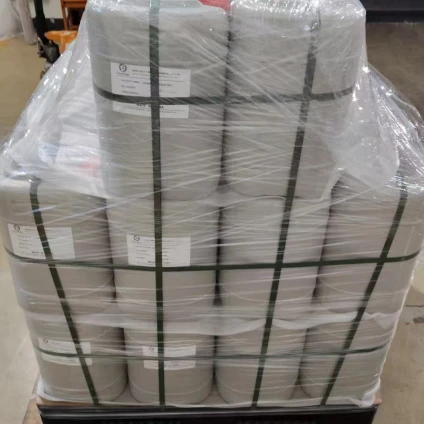
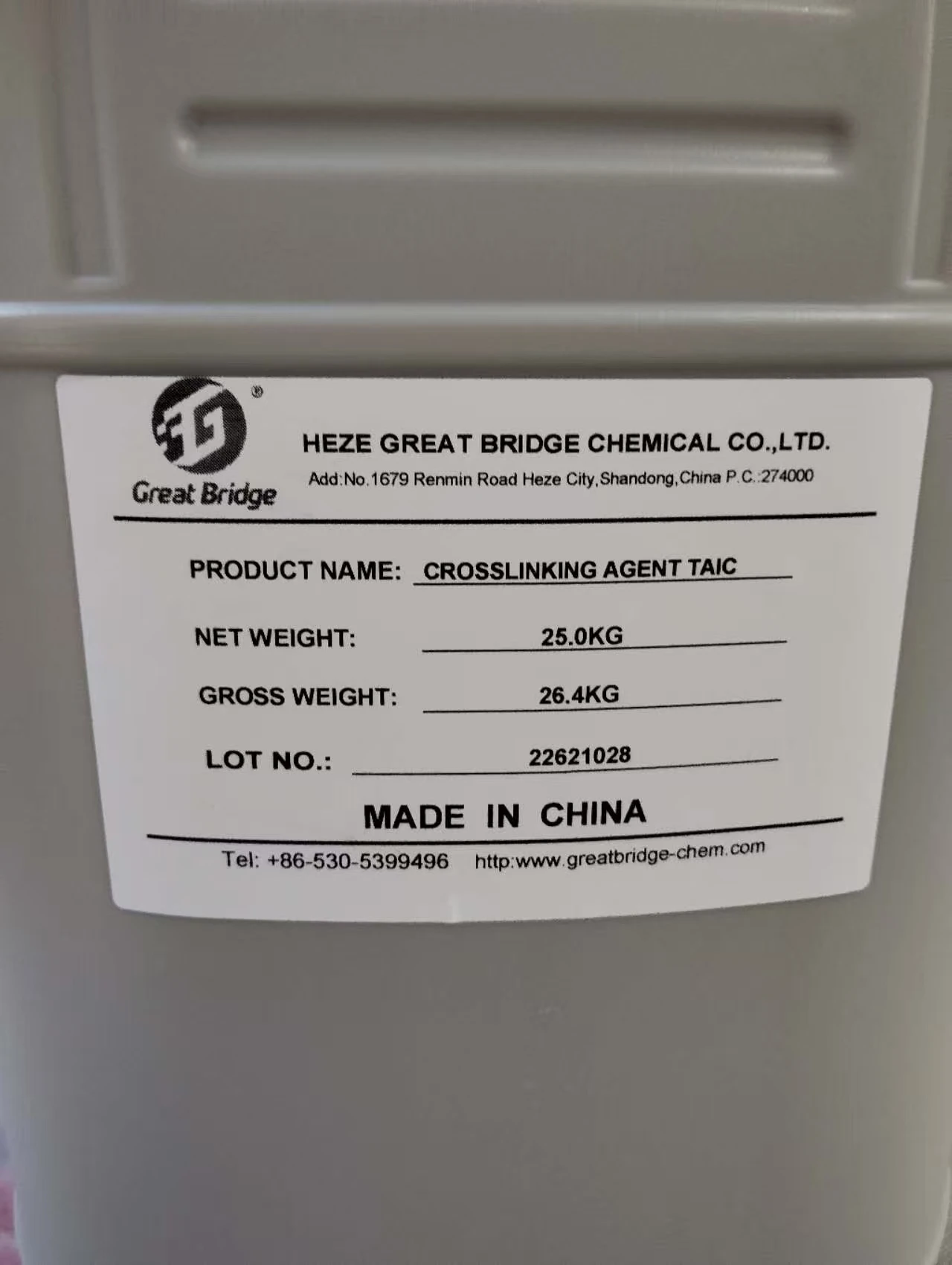
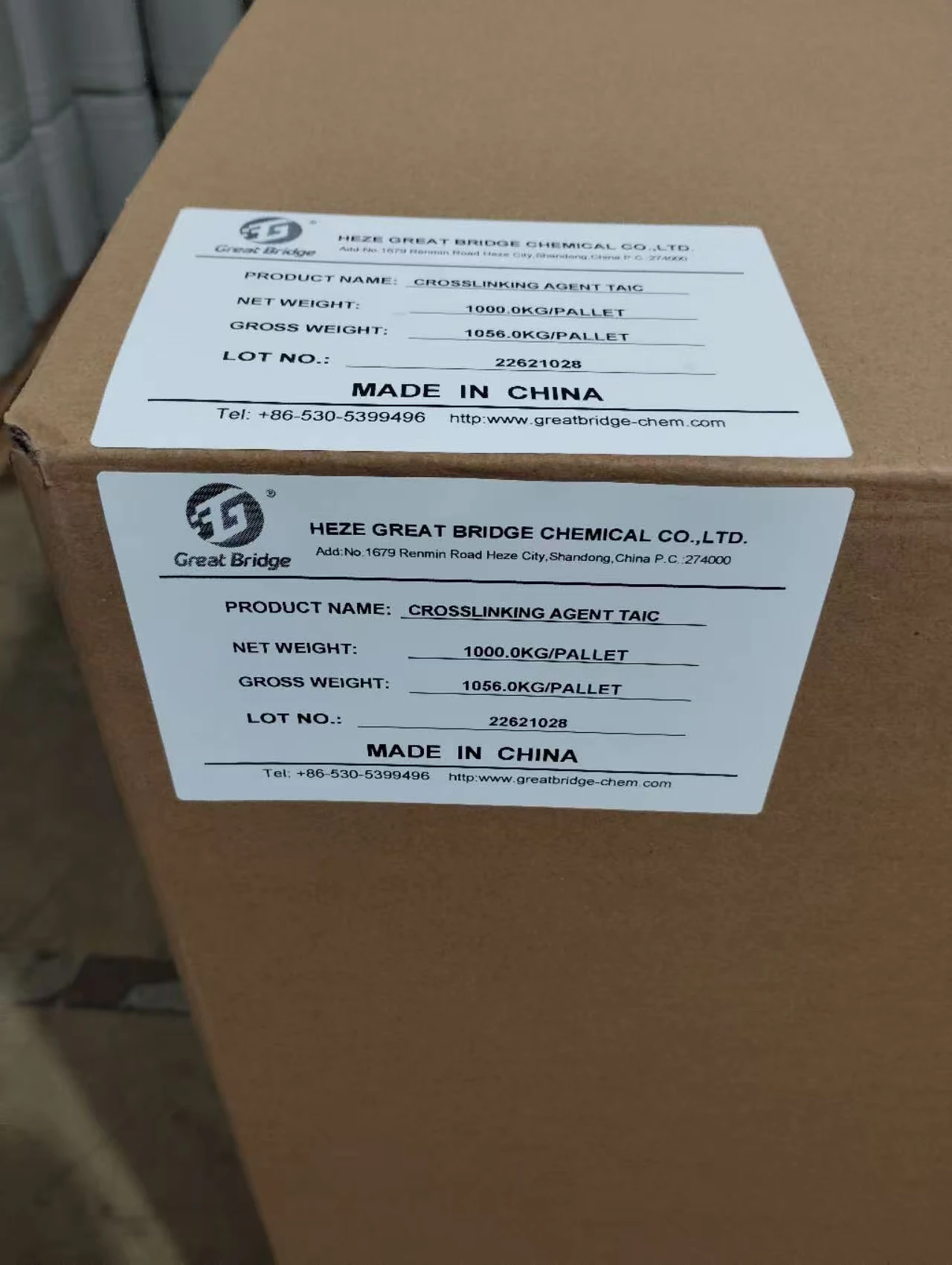
Product name: Crosslinking agent TAIC
Chemical Name: Triallyl Isocyanurate
CAS NO.: 1025-15-6
Molecular Formula: C12H15N3O3
Molecular Weight: 249.27
Structural formula:

Specification
|
Item |
Specification |
|
Appearance |
Clear Liquid / Crystal |
|
Active conten ≥% |
≥99% |
|
Hue |
≤50 (Pt-Co) |
|
Acid value |
≤0.3 (mg KOH/g) |
Properties
TAIC features excellent stability under ambient conditions and allows long-term storage at room temperature. Its molecular structure contains three allyl functional groups, endowing it with the typical reactivity of aliphatic olefins, including diverse addition reactions, homopolymerization, copolymerization and the Prins reaction. Triggered by peroxide initiators, TAIC exhibits higher polymerization activity compared with other allyl compounds. When heated above 140℃ in air, it self-polymerizes to form a rigid, transparent homopolymer.
Application
- TAIC serves broadly as a crosslinker, modifier and co-vulcanizing agent for thermoplastics, ion-exchange resins, specialty rubbers and other polymeric materials. It also functions as an intermediate/additive for photocurable coatings, photoresists and flame retardants.
- It acts as the crosslinking agent for EVA sheets used in solar cell encapsulant films.
- For specialty rubbers including EPDM, various fluororubbers and CPE, TAIC works alongside DCP as a vulcanization accelerator. Typically dosed at 0.5–4%, it greatly shortens curing cycles while boosting tensile strength, abrasion resistance, solvent resistance and corrosion resistance.
- It is applied in crosslinking acrylic and styrenic ion-exchange resins. Compared with divinylbenzene crosslinkers, it achieves superior performance at lower loading levels. It enables the production of high-performance ion-exchange resins featuring anti-fouling capacity, high mechanical strength, large pore size, thermal stability, acid/alkali resistance and oxidation resistance. This category represents a newly developed, high-potential ion-exchange resin system both domestically and internationally.
- It is utilized to modify polyacrylates and polyalkylacrylates, delivering notable improvements in heat resistance, optical properties and processability. A typical application is thermal modification of conventional PMMA (organic glass).
Package and Storag
For liquid TAIC, packed in metal drum. Net weight is 200kg or 25kg.
Store in a cool, dry, ventilated area with container kept hermetically closed. Storage temperature shall not exceed 30℃. Avoid light exposure and heat. Isolate from incompatible substances including peroxides, strong oxidizing agents, strong acids and alkalis to prevent spontaneous polymerization. The product remains valid for 12 months from production date if stored as instructed.
FAQ
1. Does crystallization of liquid TAIC at low temperature mean the product is degraded and unusable?
TAIC has a melting point of around 21℃. Crystallization at low temperature is a normal physical change rather than deterioration. Place the sealed drum in a 30–40℃ warm water bath or warm room for slow warming. Once fully melted and homogenized by stirring, its chemical properties and crosslinking activity remain unchanged for normal production. Rapid high‑temperature heating is forbidden to prevent self‑polymerization.
2. Compared with divinylbenzene, what are the key advantages of TAIC as crosslinker for styrenic ion‑exchange resin?
TAIC delivers equivalent crosslinking efficiency at lower dosage. The crosslinked network is more stable, endowing final resin with superior oxidation resistance, acid & alkali resistance and anti‑fouling capacity. It is suitable for manufacturing macroporous, high‑strength specialty ion exchange resin. Its main drawback is higher cost than DVB. DVB is still preferred for standard general‑purpose resin.
3. What is the difference between TAIC and common acrylate crosslinkers when applied in photocurable coatings and photoresists?
With three allyl groups, TAIC imparts better heat resistance and higher thermal deformation temperature to cured films. Nevertheless, its photoinitiation rate is lower than acrylate monomers. It is normally adopted as a functional co‑additive to boost thermal and solvent resistance, instead of the main photocurable monomer.


Hot Tags: crosslinking agent taic liquid, China crosslinking agent taic liquid manufacturers, suppliers, factory


