



Chemical Name: Polyethylene Glycol 6000
Synonyms: Macrogol 6000, PEG 6000, Polyglycol, Polyethylene oxide, Polyoxyethylene
Molecular Formula: HO(CH2CH2O)nH
Molecular Structure: 
CAS No.: 25322-68-3
Specification
|
Appearance (25℃) |
OH Value,mg KOH/g |
Moisture,(%) |
Chroma(AHPH) |
pH |
Freezing point(℃) |
|
White Solid |
18-19 |
≤0.50 | ≤50 |
5.0-7.0 |
55-61 |
|
-- |
GB/T 7383-2007 | GB/T 11275-2007 | GB/T 9282 .1-2008 | GB/T 6368-2008 |
-- |
Description
PEG6000 is condensation polymers of ethylene oxide and water.It is the most commercially important type of polyether. Polyethylene glycols are nontoxic, odorless, neutral, lubricating, nonvolatile and nonirritating and are used in a variety of Industrial applications suchas adhesives, ceramic, pulp and paper, metalworking, lubricants, agrochemicals, detergents and cleaners.
Application
PEG4000 are used in a variety of Industrial applications such as adhesives, ceramic, pulp and paper, mtalworking, lubricants, agrochemicals, detergents and cleaners. Used as emulsifier, additive, stabilizer, lubricant, solubilizing agent, washing agent, dispersing agent, parting agent, plasticizing agent, thickening agent, filling agent, viscosity conditioning agent and chemical intermediate in the industry.
Package
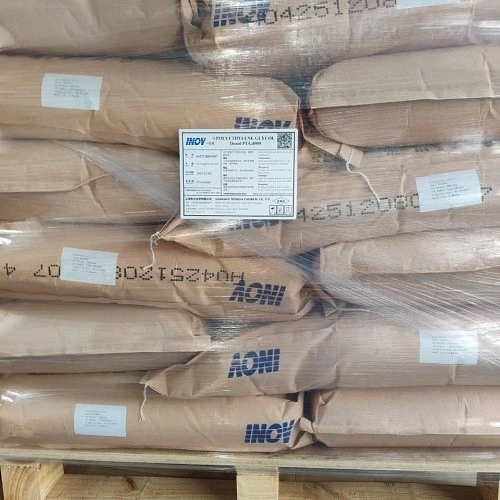
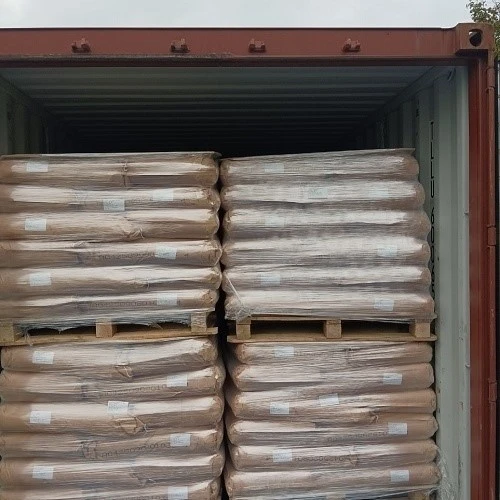
25kgs/bag
Storage
1. Store in dry, well-ventilated and cool warehouse.
2. Avoid of direct sunlight, rain, far from water and fire.
3. Non-flammable & non- explosive products.
Validity
1 years in correct storage condition.
FAQ
1. Why is PEG 6000 described as a condensation polymer instead of a single pure compound with a fixed molecular weight? PEG 6000 is a polymeric mixture formed by the polycondensation of ethylene oxide and water. Its molecular formula is expressed as HO(CH₂CH₂O)ₙH, where n is an average value rather than a fixed number. There is a certain molecular weight distribution in each batch, which is a normal characteristic of polyethylene glycol products.
2. Is PEG6000 compatible with anionic, cationic and nonionic surfactants?
Yes. PEG 6000 itself is a nonionic polyether substance with good compatibility with most anionic, cationic and nonionic surfactants. It is widely used as solubilizer, dispersant and lubricant in detergent and agrochemical formulations.
3. What are the limitations of PEG 6000 compared with PEG4000 in practical application?
PEG 6000 has a higher average molecular weight, higher freezing point and lower hydroxyl value than PEG 4000. It is more suitable for scenarios requiring higher viscosity, better film-forming and lubricating properties, while its water solubility and fluidity at room temperature are poorer than PEG 4000.
Hot Tags: peg 6000 for rubber industry, China peg 6000 for rubber industry manufacturers, suppliers, factory, PEG 4000 For Rubber Industry, PEG 4000 Industrial Grade, processing aid


