



Chemical Name: 4,4'-dithiodimorpholine
CAS No.: 103-34-4
STRUCTURAL FORMULA:
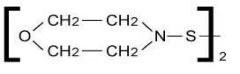
MOLECULAR WEIGHT: 236

Specification
| Item | Crystal | Oiled crystal | Granule |
| Appearance | White crystal(granule) | ||
| Initial M.P. οC ≥ | 120 | 120 | 120 |
| Loss on drying % ≤ | 0.3 | 0.4 | 0.3 |
| Ash % ≤ | 0.3 | 0.4 | 0.3 |
| Residues on 840μm sieve, % ≤ | 0 | 0 | -- |
| Additive, % | -- | 0.0-1.0 | -- |
| Granule Diameter, mm | -- | -- | 2.5 |
Properties
Appearance: White crystalline solid or powder.
Specific gravity: 1.28‑1.32.
Toxicity: Non‑toxic.
Solubility: Soluble in benzene, alcohol and acetone; insoluble in water.
Application

Key Features & Benefits
- Acts as a sulfur‑donor vulcanizing agent for efficient and semi‑efficient vulcanization cure systems. Delivers heat, reversion and aging resistance for natural rubber (NR) and synthetic rubbers.
- Non‑blooming characteristic with excellent storage stability.
- Dual‑function material: serves as both vulcanizing agent and accelerator for natural & synthetic rubbers.
- Releases active sulfur only at vulcanization temperature, preventing scorch and ensuring safe processing.
- Slow curing speed when used alone; cure rate can be boosted by blending with thiazole, thiuram or dithiocarbamate accelerators.
- Note: Salicylic‑acid‑based additives speed up decomposition but may deteriorate physical performance of vulcanizates.
- High effective‑sulfur content enables lower sulfur addition when applied as an accelerator.
- Prevents blooming, staining and discoloration of rubber mixes; end‑products obtain good heat and aging resistance in efficient / semi‑efficient vulcanization systems.
Handling Precautions
For detailed information on toxicological and handling precautions please refer to current Safety Data Sheet. This information sheet can be requested from Great Bridge Chemical and should be consulted before using this product.
Packaging
25kg plastic woven bag, paper wilh plastic film bag, kraft paper bag
Storage
Store DTDM on single‑stack pallets within a cool, dry and well‑ventilated warehouse. Protect packaged goods from direct sunlight. Avoid double‑stacking pallets, as excessive compression of the product may occur. High humidity or elevated temperatures will trigger material degradation, which can shorten the scorch time of rubber compounds. Do not store DTDM in proximity to Crystex. Amine vapors released by DTDM may cause Crystex to revert to rubber‑maker's sulfur.
FAQ
Q1: Does DTDM release active sulfur at room temperature?
No. DTDM decomposes and releases active sulfur only under vulcanization temperature. This characteristic effectively prevents premature scorch and ensures safe processing.
Q2: Why is the cure rate slow when DTDM is used alone?
DTDM shows relatively slow vulcanization speed on its own. You can accelerate curing by combining it with thiazole, thiuram or dithiocarbamate‑type accelerators.
Q3: Can salicylic acid‑based additives be used together with DTDM?
Salicylic‑acid‑based substances will speed up DTDM decomposition and raise cure rate. However, they may impair the physical properties of the final vulcanized rubber, so careful formulation testing is required.
Q4: Can DTDM reduce sulfur dosage in rubber formula?
Yes. Thanks to its high effective‑sulfur content, DTDM can act as an accelerator and allow proper reduction of added elemental sulfur.
Q5: What advantages does DTDM bring to rubber compounds?
It provides excellent heat, reversion and aging resistance for NR and synthetic rubber. It is non‑blooming and avoids compound staining and discoloration. It also has good storage safety.
Q6: What are the key storage requirements for DTDM?
Store on single‑stack pallets in cool, dry, well‑ventilated warehouse. Keep packages away from direct sunlight. Do not double‑stack pallets to avoid product compaction. Avoid high humidity and high temperature, which cause degradation and shorter scorch time.
Hot Tags: dtdm rubber sulfur donor vulcanizing agent, China dtdm rubber sulfur donor vulcanizing agent manufacturers, suppliers, factory, rubber vulcanizing agent, Rubber Vulcanizing Agent DTDC, Rubber Vulcanizing Agent DTDM, Rubber Vulcanizing Agent PDM


