

What is the mechanism of action of rubber accelerators?
As a supplier of rubber accelerators, I've witnessed firsthand the transformative power of these remarkable chemicals in the rubber industry. Rubber accelerators are substances that significantly speed up the vulcanization process of rubber, which is the cross - linking of polymer chains in rubber to enhance its mechanical properties. In this blog, we will delve into the mechanism of action of rubber accelerators, exploring how they work and their importance in the rubber manufacturing process.
The Basics of Vulcanization
Before we discuss the role of accelerators, it's essential to understand vulcanization. Vulcanization was a revolutionary discovery by Charles Goodyear in 1839. It involves heating natural or synthetic rubber with sulfur, which forms cross - links between the long - chain polymer molecules of rubber. These cross - links give the rubber improved strength, stability, elasticity, and resistance to heat and abrasion. However, the unaccelerated vulcanization process is slow, time - consuming, and requires high temperatures. This is where rubber accelerators come into play.
How Rubber Accelerators Work
Activation of Sulfur
One of the primary mechanisms through which rubber accelerators function is by activating sulfur molecules. In the absence of an accelerator, sulfur needs to be heated to a relatively high temperature (usually above 140°C) to break its S₈ ring structure and form reactive sulfur species. Accelerators act as catalysts, lowering the activation energy required for sulfur to react with the rubber polymer.
For instance, some accelerators can break the S - S bonds in sulfur more easily by forming intermediate complexes. These complexes are more reactive than elemental sulfur, enabling the sulfur to react with the double bonds in the rubber polymer chains at lower temperatures and in a shorter time frame. This leads to a more efficient vulcanization process.
Formation of Reactive Intermediates
Rubber accelerators can also form reactive intermediates during the vulcanization process. These intermediates react with the rubber polymer and sulfur to form cross - links. For example, many accelerators contain nitrogen or sulfur atoms that can form radicals or ions.
These reactive species can initiate a series of chemical reactions. First, they react with sulfur to form sulfur - containing radicals or ions. Then, these species react with the double bonds in the rubber polymer, creating a site for further sulfur addition. This process continues until a network of cross - links is formed between the polymer chains.
Promotion of Cross - Link Formation
Accelerators play a crucial role in the formation of different types of cross - links. There are mainly three types of sulfur cross - links: monosulfidic ( - S - ), disulfidic ( - S - S - ), and polysulfidic ( - Sₓ - where x > 2). The type of cross - link formed can significantly affect the properties of the vulcanized rubber.
Some accelerators can control the ratio of these different cross - links. For example, certain sulfenamide accelerators tend to favor the formation of monosulfidic and disulfidic cross - links. These cross - links are more thermally stable and give the rubber better aging resistance. On the other hand, some thiuram accelerators can promote the formation of polysulfidic cross - links, which provide high initial strength and flexibility to the rubber.
Types of Rubber Accelerators and Their Mechanisms
Thiazole Accelerators
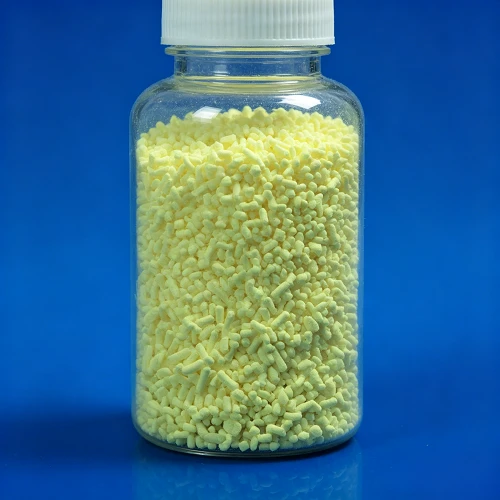
Thiazole accelerators, such as Rubber Accelerator MBT (M) Granule, are widely used in the rubber industry. MBT contains a thiazole ring structure with a sulfur atom. During vulcanization, MBT can react with sulfur to form a reactive intermediate.
The nitrogen and sulfur atoms in the thiazole ring can participate in chemical reactions. They can break the S₈ ring of sulfur and form a complex. This complex then reacts with the double bonds in the rubber polymer. The reaction of MBT with sulfur also generates free radicals that can initiate the cross - linking process, leading to the formation of a three - dimensional network of cross - linked rubber.
Sulfenamide Accelerators
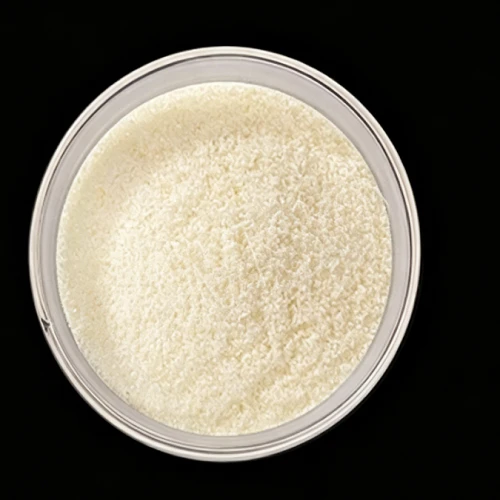
Sulfenamide accelerators, like DCBS(DZ) Powder and Rubber Accelerators TBBS, are known for their delayed - action properties. They have a relatively slow reaction rate at lower temperatures, which gives the rubber compound good processing safety.
At higher temperatures, sulfenamide accelerators decompose to release an amine and a reactive sulfur species. The reactive sulfur species then reacts with sulfur and the rubber polymer to form cross - links. The amine released can also act as a secondary accelerator, further enhancing the vulcanization process. This two - step mechanism allows for better control of the vulcanization process, ensuring that the rubber can be processed easily before the actual cross - linking occurs.
Thiuram Accelerators
Thiuram accelerators, such as Rubber Accelerators TMTM and TMTD, are very strong accelerators. They contain two or more thio groups ( - S - ) attached to a central nitrogen atom.
Thiuram accelerators can react directly with sulfur to form highly reactive sulfur - containing radicals. These radicals can quickly react with the double bonds in the rubber polymer, leading to rapid cross - link formation. Due to their high reactivity, they are often used in combination with other accelerators to achieve a balanced vulcanization rate and to control the type of cross - links formed.
Dithiocarbamate Accelerators
Dithiocarbamate accelerators are another class of accelerators. They are extremely fast - acting and are often used in low - temperature vulcanization processes. These accelerators form metal complexes, which can activate sulfur and promote cross - link formation.
The metal in the dithiocarbamate complex can interact with sulfur atoms, making them more reactive. The dithiocarbamate part of the molecule can also react with the rubber polymer to facilitate the cross - linking process. However, they are also prone to over - vulcanization, so they are usually used in small amounts in combination with other accelerators.
Importance of Understanding the Mechanism
Understanding the mechanism of action of rubber accelerators is crucial for rubber manufacturers. It allows them to select the appropriate accelerator for a specific application. For example, if a rubber product requires high heat resistance, an accelerator that promotes the formation of monosulfidic cross - links, such as some sulfenamide accelerators, would be a good choice.
Moreover, by understanding how accelerators work, manufacturers can optimize the vulcanization process. They can adjust the accelerator dosage, temperature, and time to achieve the desired properties of the vulcanized rubber. This not only improves the quality of the rubber products but also reduces production costs by minimizing processing time and energy consumption.
As A Supplier
As a supplier of rubber accelerators, we are committed to providing high - quality products and in - depth technical support. Our Rubber Accelerators ZMBT is one of our popular products, known for its excellent accelerating properties and compatibility with various rubber compounds.
We understand that different customers have different requirements for rubber products. Whether you are in the tire manufacturing industry, the rubber hose industry, or any other rubber - related field, we can help you select the most suitable rubber accelerator. If you are interested in our products or need more information about the mechanism of rubber accelerators and how they can be applied to your production process, please feel free to contact us for a purchasing discussion.
References
- Morton, M. (1993). Rubber Technology. Van Nostrand Reinhold.
- Waddell, W. H. (2001). The Chemistry and Physics of Rubber - Like Substances. J. Wiley.
- Mark, J. E. (2007). Physical Properties of Polymers Handbook. Springer.